


The market is undergoing the biggest strategic shift in coal plant offers for more than 16 years. Forward prices for the current quarter are the highest since the exceptional 2022 year and NSW Q4-26 has almost doubled in the last 5 weeks. Meanwhile Cal-27 prices across all regions have surged.
Over the last 5-weeks, NSW Cal-27 forward prices have increased by almost $19/MWh, QLD about $9/MWh, VIC about $10/MWh, SA about $6/MWh, and finally TAS about $9/MWh. What is going on, and why is it so?
The backdrop to this significant shift and rally in spot and forward market prices is:
- Spot outcomes in each quarter since July last year have consistently failed to live up to pre-quarter forward market expectations. There are a few exceptions, but the trend generally holds. This has led to forward market sellers capturing a significant profit. This held true until the start of Q4-26 on 1 October.
- More than 16 years ago, it was common practice to watch base load coal plant put capacity-at-risk by offering capacity into extreme price levels to try to induce some price volatility. By doing so, if the extreme prices did not occur, then the generator incurred the opportunity loss of spot revenue. However, the prize for adopting such a strategy was that if volatile prices occurred, spot revenue increased, but more importantly the forward market would likely strengthen. Such a rally would provide longer-term leveraged benefits of higher future revenue and higher regulated tariffs.
- As intermittent generation increased, this induced a natural price volatility evident by Triple 'C' Days (cold, calm and cloudy). The need for coal plant to actively induce price volatility dissipated as it became a natural occurring phenomena. However, as the surge in battery capacity has grown, this intermittent induced volatility has now been compressed.
- The re-emergence of the pre-2010 strategy of NSW coal plant trying to induce price volatility seems to have re-emerged; coinciding when NSW coal plant outages have been relatively high.
- Spot price outcomes since 1 October have surged.
Spot Price Recent History
The spot prices up to and including September have been rather subdued.
The prospect of the continuation of these subdued prices may not have pleased some of the market players.
Based on our probabilistic spot forecast, it has been our view that 2026 and 2027 would be the low points in the price cycle, and then with the planned closure of Yallourn in mid-2028, followed by Gladstone and Eraring in the first half of 2029, spot prices are expected to strengthen. Clearly, there is open debate whether these planned closures will occur as planned, and whether the market is ready to cope without this inertia-driven baseload capacity.
A State election in Victoria next month, along with the State Governments in New South Wales and Queensland and their Federal Government counterpart, will no doubt have a big say. The formal announcement of further delays to Snowy 2.0 will also no doubt be a factor.
However, it seems some market players are not prepared to wait for the 2029 rally, if it does occur.
Forward Price Rally
During September there was the biggest price rally in New South Wales next quarter prices since March 2022 (Global Energy Crisis year). The Q4-26 price increases across all regions since the low point of 9 September are:
- NSW from $73.62 to $144.40 ($70.78 increase, 96%)
- QLD from $66.38 to $93.35 ($26.78 increase, 41%)
- VIC from $38.50 to $50.00 ($11.50 increase, 30%)
- SA from $48.00 to $51.50 ($3.50 increase, 7%)
The chart below shows since 1 October, the rally in the Q4-26 forward prices along with the quarter-to-date average spot prices. NSW and QLD have surged off the back of strong spot prices, especially for NSW on 12 October when extreme prices occurred.
Looking further ahead to Cal-27, forward prices for all Regions, but especially NSW and QLD, have rapidly increased. This is the biggest rally in next year’s forward price for this time of year in the market’s history. Since the low point on 9 September, prices have increased:
- NSW from $84.62 to $103.16 ($18.54 increase, 22%)
- QLD from $74.63 to $83.62 ($8.99 increase, 12%)
- VIC from $62.55 to $72.73 ($10.18 increase, 16%)
- SA from $78.34 to $84.65 ($6.31 increase, 8%)
- TAS from $72.31 to $80.88 ($8.57 increase, 12%)
Other years of Cal-28 and to a lesser extent Cal-29 have also rallied.
The ASX traded volume during September 2026 was the highest September on record, and October 2026 has already exceeded previous October levels. Given the elevation of market prices for all future quarters and the volume traded, margins calls would have been extremely high.
Recent Spot Price Averages
September spot prices finished stronger than the market expected. In mid-August, the September forward price was much lower than the eventual spot price in VIC, NSW and SA. However, the September average was lower than last year in VIC and SA, NSW slightly softer, QLD slightly stronger and TAS stronger.
Looking at the October average spot price to date, NSW is currently on par with the record breaking Sep-22. QLD is tracking as the second highest on record, VIC and SA less than last year, and TAS almost double a very soft last year. We seem to have a north-south divide in market spot prices, which is unusual for this time of the year.
Generation Offers and Capacity
During October 2026 there has been less NSW coal available compared to the same time last year, due to outages. The chart below shows the black coal offers since October 2025 and the red colour capacity represents offers above $5,000/MWh. October 2026 has experienced less black coal available, but the proportion of capacity above $5,000/MWh has remained relatively consistent.
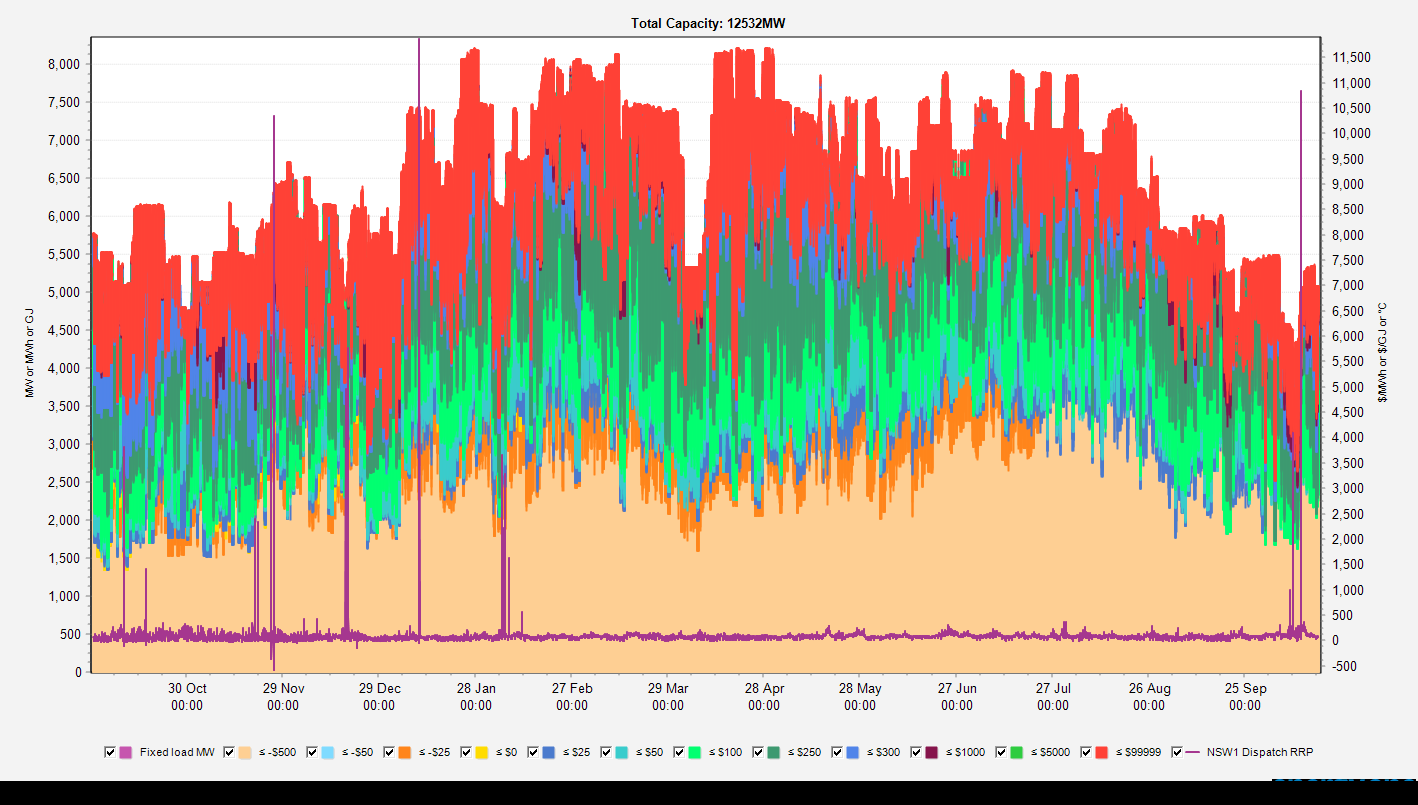
Unpacking the NSW black coal group by looking at Origin Energy (Eraring) in particular, available capacity is a bit less than same time last year, but there is a noticeable increase in the capacity offered in the above $5,000/MWh price band. Note the drop in the chart for the last month, and the relatively high proportion of offers above $5,000/MWh for this time of the year.
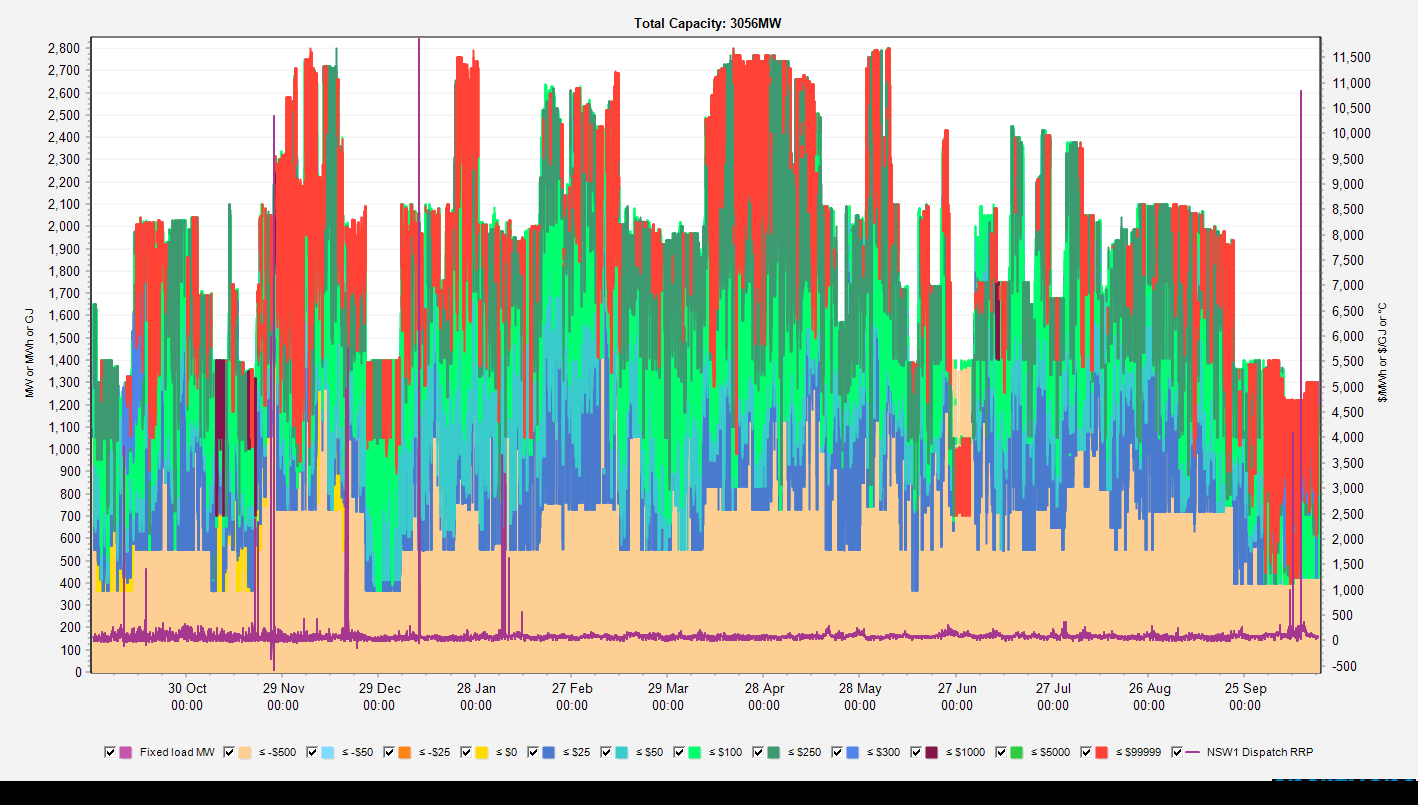
Looking at the Eraring BESS, it can also be noted the capacity offered above $5,000/MWh has noticeably increased and been more consistent since 1 October 2026.
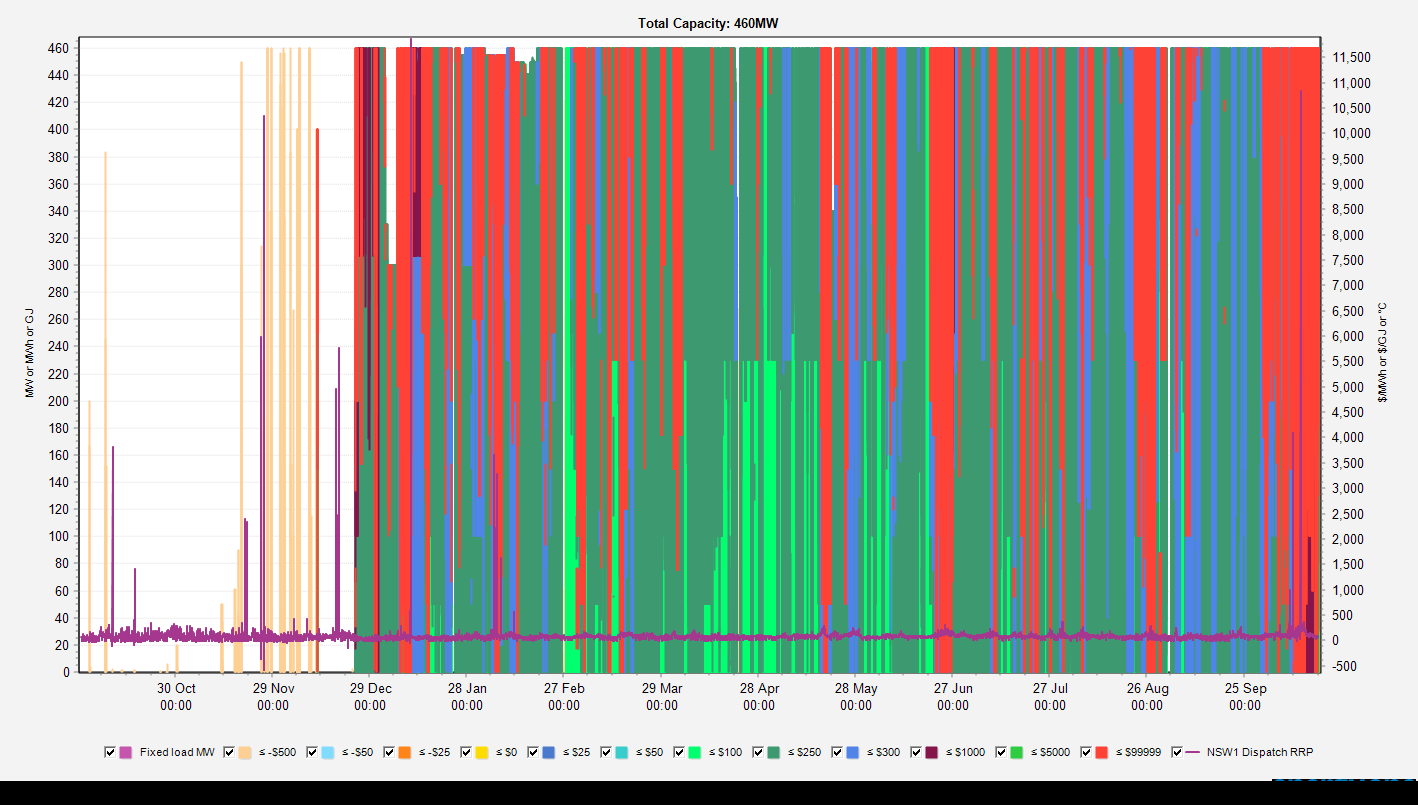
Looking at the longer history of offers from Eraring for the month of October since 2002, the 2026 year has the highest average capacity of offers above $5,000/MWh since October 2021, and is more like the 2002 to 2010 era. Assessing the average capacity above $5,000/MWh offered during the critical evening peak period of 6:00pm to 8:00pm, October 2026 also has an average capacity-at-risk more like the 2002 to 2010 era.
Over the historical period analysed, clearly 2022 was an exceptional year due the Global Energy Crisis, and 2021 was similar to 2026 (ending 30 Sep). The average spot prices are at similar levels; and then 2021 followed a soft spot price outcome the year before in 2020, so the drive for change would have been strong.
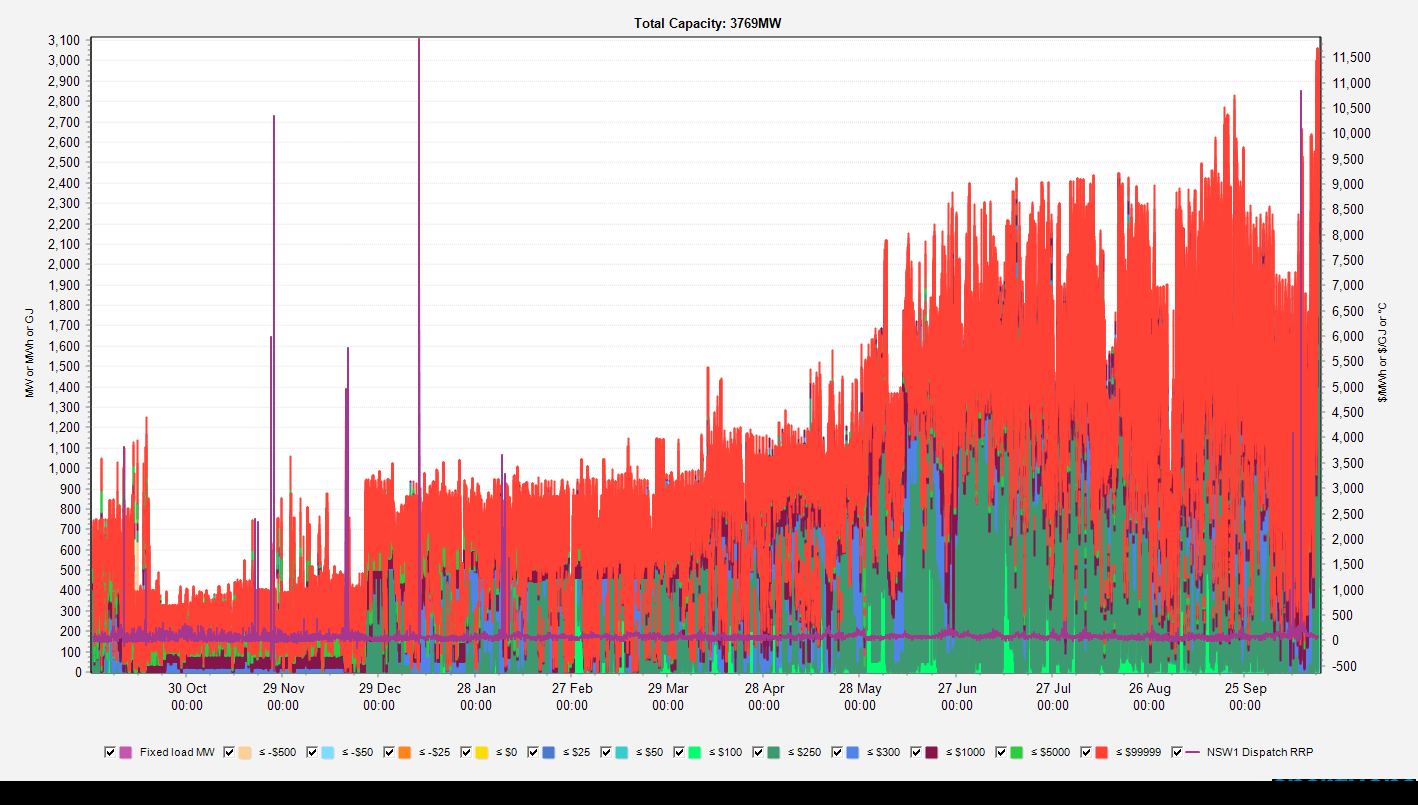
Looking at BESS collectively in NSW, the available capacity has significantly increased over the last 12-months, but looking at the most recent month, there is an exceptional proportion of high capacity offered above $5,000/MWh compared to winter of 2026.
Black coal in QLD has shown a decrease in available capacity compared to same time last year, and the capacity offered above $5,000/MWh has also decreased.
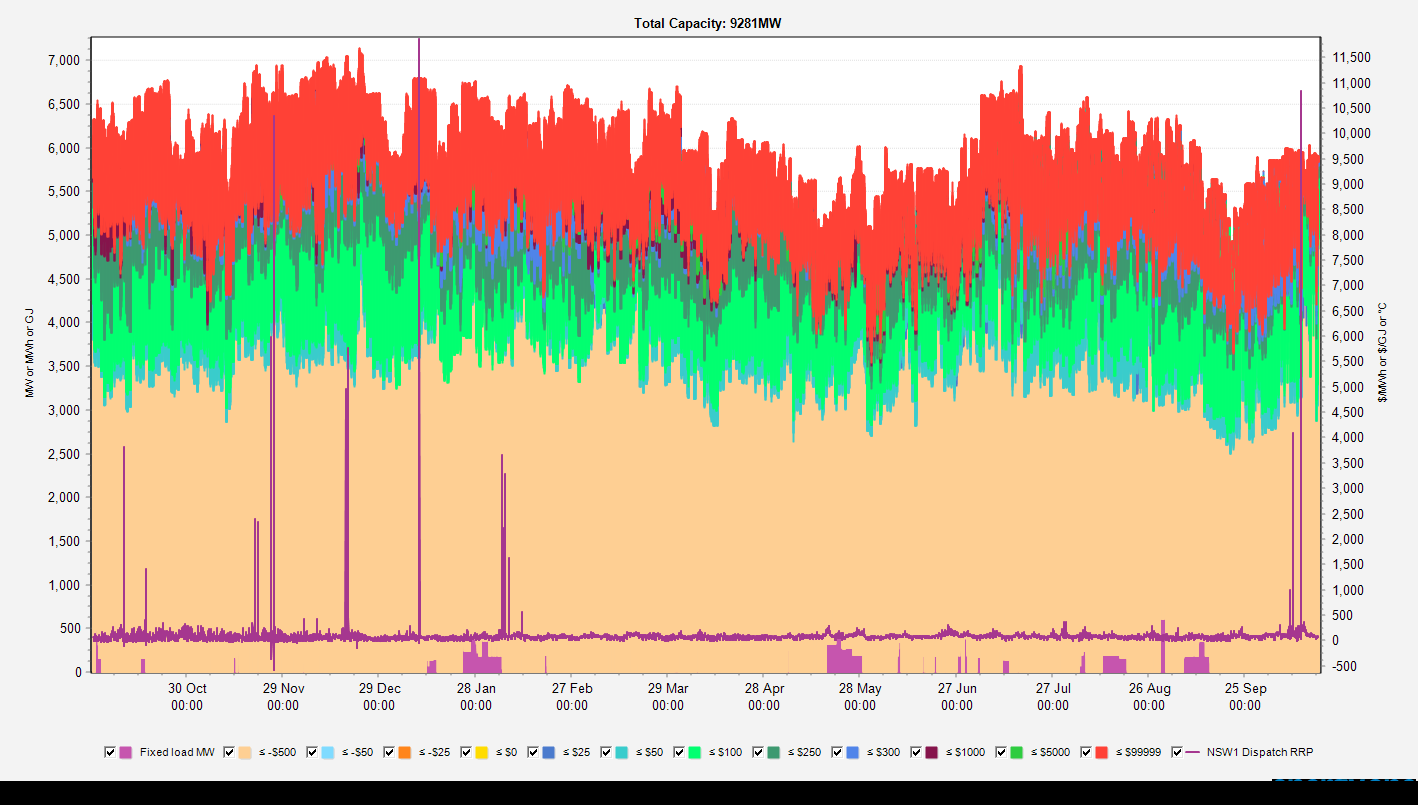
For Victorian brown coal offers, the capacity this October is higher than the same time last year, and more capacity is being offered below -$500/MWh than same time last year.
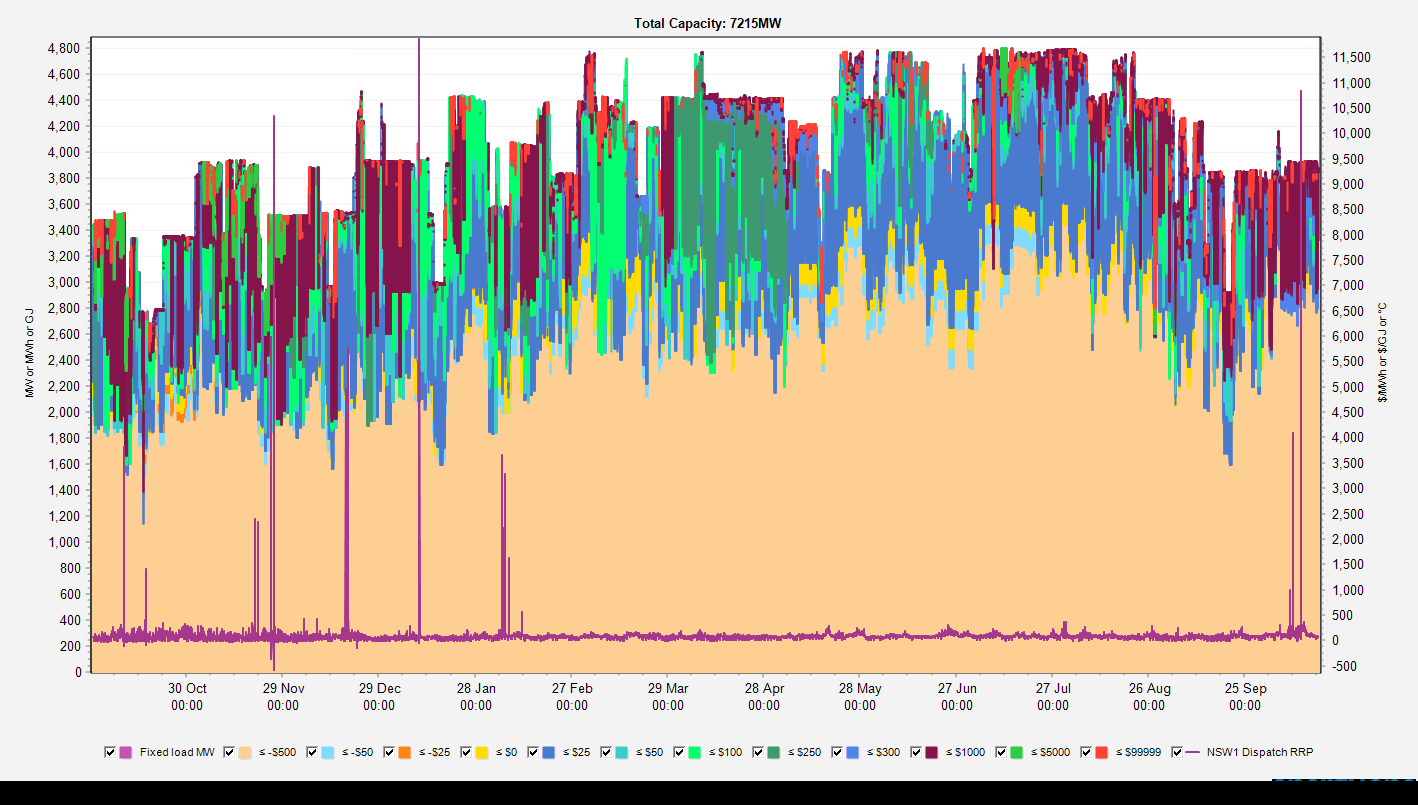
In summary, it is not unusual for coal generators to offer marginal capacity at extreme price levels. However, what is clearly evident is that Origin Eraring's proportion and magnitude of capacity above $5,000/MWh for the duration evident, is a step change from recent behaviour. In terms of the coal sector, it is more similar to the behaviour evident over the 2002 to 2010 era.
Conclusion
Sometimes strategies land on their feet, and of course when they do, many architects emerge. Whether this strategy was as well planned as the outcome suggests, we will probably never know; but it has been hugely successful for market players wanting a rally in prices from the subdued levels experienced since July last year.
Forward sellers shorting the market since July 2025 would have had material gains, but now are licking their wounds and no doubt are trying to recover and salvage their financial position. I recall the first time the financial market took on the physical market, way back in the VIC summer of 2000. A trading house sold large positions with the expectation of low spot prices, following the pattern of low prices in the years beforehand. The physical market players formed a different view and bought these contracts. Then the weather gods intervened during the Australian Open tennis tournament: demand surged, generators holding longer positions were able to re-price their generation, and spot prices lifted materially. Before the end of the financial year, the trading house closed shop, and the investors lost their money.
We watch with interest the next chapter.
Disclaimer and Notes
Energybyte is published by Empower Analytics Pty Ltd (ABN 38630239002), Authorised Representative no 1274453 of Capital Treasury Solutions (AFSL 429066). Any questions or feedback must be directed to Empower Analytics Pty Ltd as the sole publisher.
